





Now, we're coming to the juiciest part of our three-part mini-series on real-world Wi-Fi testing - to RESULTS (for test setup, please refer to the first part on the routers-we-used and the second part on the adapters).
Cold Hard Data
5GHz Results
| AC8260 Dn | AC8260 Up | ALFA Dn | ALFA Up | NET-DYN Dn | NET-DYN Up | AC3165 Dn | AC3165 Up | Kootek Dn | Kootek Up | Supremery Dn | Supremery Up | ||
| Nighthawk X8 | 559,11 | 491,98 | 1,05 | 275,80 | 272,30 | 282,55 | 161,40 | 183,30 | 1,41 | 235,95 | 252,90 | 156,70 | |
| AirPort | 394,45 | 305,70 | 77,45 | 50,55 | 312,90 | 306,55 | 148,20 | 107,50 | 76,80 | 46,55 | 148,80 | 284,70 | |
| ASUS-5300 | 612,48 | 460,00 | 1,87 | 260,16 | 431,85 | 441,85 | 159,80 | 182,90 | 0,53 | 201,50 | 170,90 | 143,60 | |
| ASUS-3200 | 578,57 | 362,08 | 2,18 | 213,89 | 334,30 | 453,70 | 170,30 | 184,50 | 3,30 | 189,30 | 25,00 | 134,50 | |
| ASUS-58U | 204,50 | 387,91 | 1,90 | 260,00 | 356,10 | 476,00 | 184,40 | 184,50 | 174,50 | 157,90 | 221,30 | 128,80 | |
| WE 1326 | 423,79 | 293,72 | 210,94 | 276,73 | 325,53 | 291,58 | 159,40 | 163,40 | 180,15 | 158,05 | 25,00 | 134,90 | |
| Archer C2 | 224,50 | 231,25 | 195,81 | 237,09 | 215,85 | 258,55 | 168,90 | 182,30 | 107,35 | 151,74 | 140,40 | 101,00 | |
| Theoretical | 867,00 | 867,00 | 867,00 | 867,00 | 867,00 | 867,00 | 433,00 | 433,00 | 433,00 | 433,00 | 433,00 | 433,00 |
All results are in MBit/sec; 'Dn' means 'from router to adapter', and 'Up' means 'adapter to router'; as it was mentioned before - all the results are for a single TCP connection.
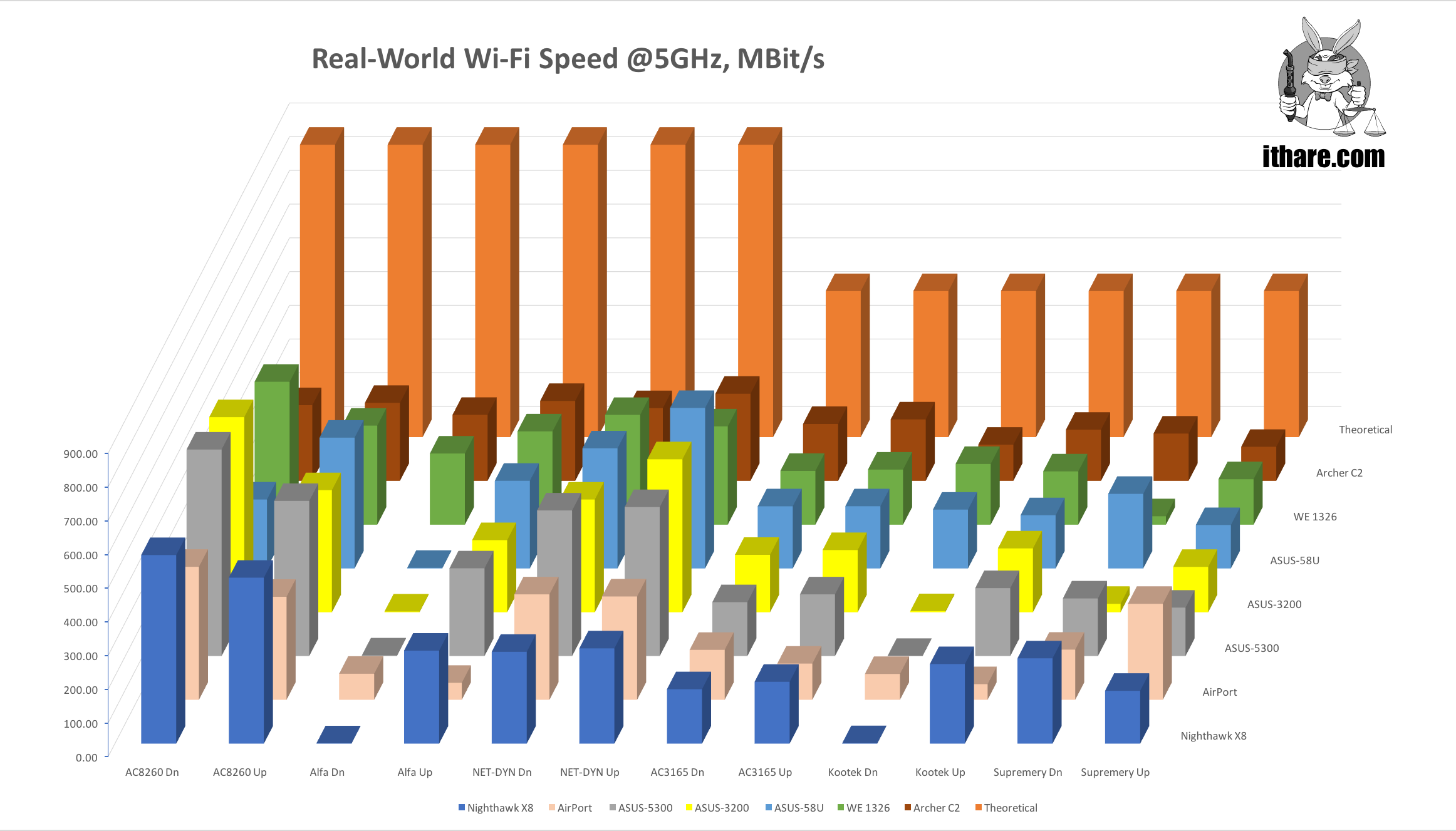
The same results can be seen in the following picture:
2.4GHz Results
Similar data for 2.4 GHz look as follows:
| AC8260 Dn | AC8260 Up | ALFA Dn | ALFA Up | NET-DYN Dn | NET-DYN Up | AC3165 Dn | AC3165 Up | Kootek Dn | Kootek Up | Supremery Dn | SupremeryUp | ||
| Nighthawk X8 | 111,71 | 96,76 | 1,60 | 98,21 | 104,5 | 95,75 | 47,2 | 45,2 | 1,86 | 43,05 | 26,1 | 54,6 | |
| AirPort | 92,53 | 113,80 | 77,95 | 61,20 | 102,5 | 106,3 | 97,7 | 66,9 | 46,10 | 35,85 | 38,1 | 56,9 | |
| ASUS-5300 | 195,89 | 212,19 | 203,60 | 176,13 | 28,6 | 21,18 | 82,2 | 84,3 | 1,26 | 81,35 | 118,3 | 95,1 | |
| ASUS-3200 | 205,07 | 167,04 | 2,25 | 0,001 | 138,75 | 129,45 | 86,7 | 78,4 | 125,73 | 92,95 | 113,2 | 96,5 | |
| ASUS-58U | 204,50 | 185,21 | 1,45 | 172,90 | 190,9 | 183,6 | 84,7 | 82,2 | 101,80 | 82,90 | 105,2 | 40,5 | |
| WE 1326 | 167,24 | 163,07 | 149,44 | 174,33 | 183,2 | 164,8 | 82,1 | 79,2 | 96,85 | 79,25 | 102,6 | 65,4 | |
| Archer C2 | 145,75 | 102,00 | 120,87 | 145,09 | 120,05 | 114,1 | 77,5 | 85,1 | 100,25 | 98,68 | 103,3 | 95,1 | |
| Theoretical | 300,00 | 300,00 | 300,00 | 300,00 | 300,00 | 300,00 | 300,00 | 300,00 | 150,00 | 150,00 | 150,00 | 150,00 |
And graphical representation of the same thing can be seen on the following graph:
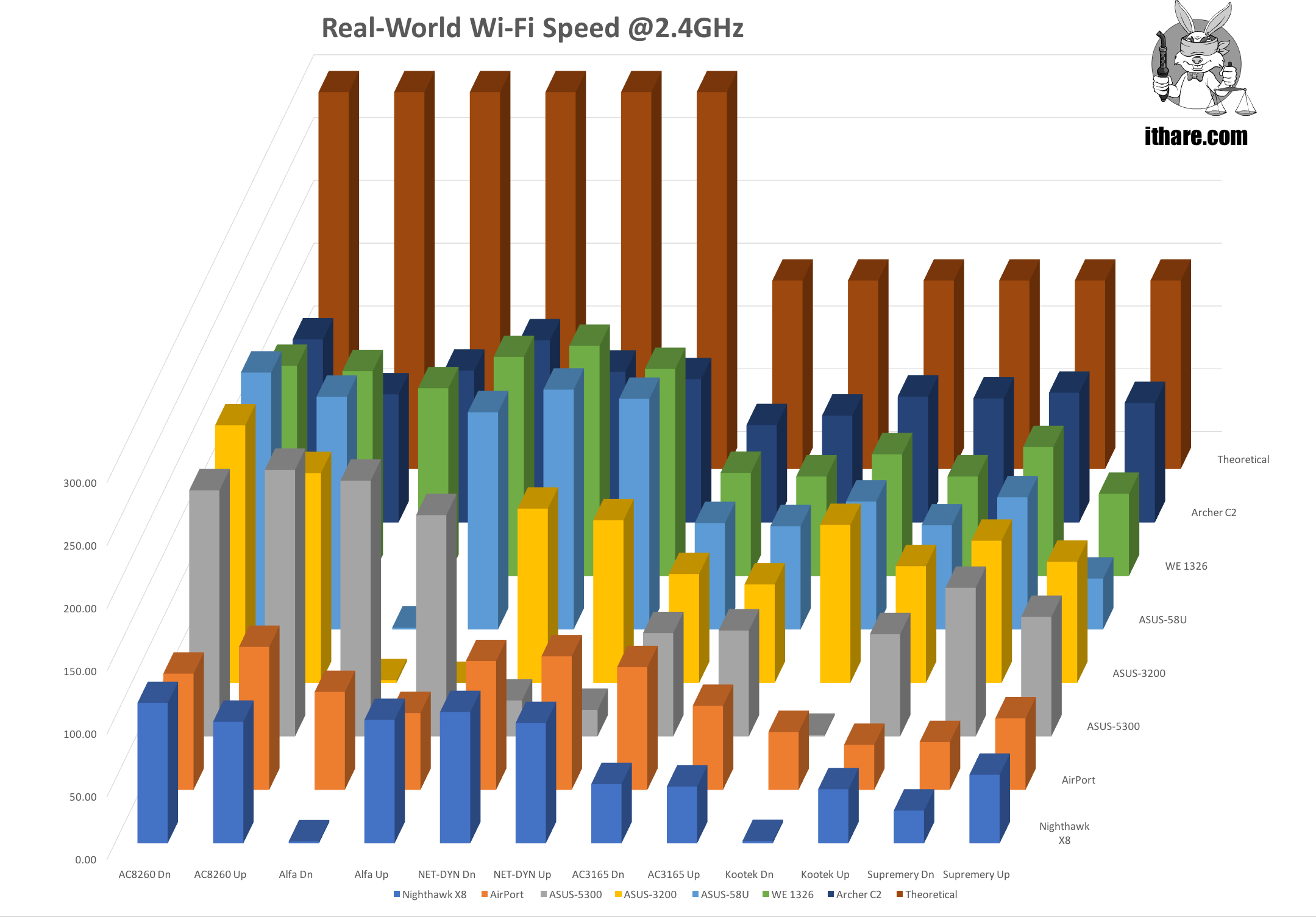
1 not able to connect
Conclusions
Now, let's try to make some generalizations and conclusions based on the data above. As usual, everything goes with a Big Fat Disclaimer(tm) that all the conclusions are based on a limited data set, and that the picture can change in the future, and that YMMV, etc. etc. Still, IMO the following can be said with more-or-less confidence:
There is no such thing as "the best router"; strictly speaking - you need to test each specific pair of (router,adapter) to get anywhere-reliable results. There is no such thing as 'the best router'; strictly speaking - you need to test each specific pair of (router,adapter) to get anywhere-reliable results.
 - Our results for some of the adapters are better than those which were observed in Winkle2013; whether it indicates a difference in testing setups, or an overall improvement in Wi-Fi routers/adapters over these 4 years - is unclear, but being an optimist, I certainly hope for the latter .
- It seems that we've got to the point when we can occasionally get to 50% (and sometimes even to 70%) of the theoretical bandwidth, which isn't bad.
- As long as we're speaking about the trivial Wi-Fi network with laptops connected directly to routers - all 2x2 802.11ac/802.11n routers and above, are about the same. In particular, there is no obvious correlation between router price and measured speeds. Sure, it is a logical consequence of us using only 1x1 and 2x2 adapters, but as these adapters tend to dominate the laptop market by far, this choice of adapters is just a reflection of real-world realities. On the other hand, as soon as we get our clavicles on 3x3 laptop adapter - we'll add it to the mix (but won't add too many of them to avoid skewing the picture).
- As for the adapters - they DO matter, and A LOT. Here, we can (still very tentatively at this point) observe the following properties:
- built-in laptop adapters tend to outperform comparable USB adapters. In other words - think twice before buying 2x2 USB adapter to replace your 2x2 built-in adapter.
- When speaking about the chipsets and manufacturers - there is a so-far-rather-clear hierarchy:
- The best ones are those by Intel (AC****); however, AFAIK, Intel doesn't produce USB-enabled Wi-Fi chips, so building a USB adapter on top of Intel chips is going to be expensive (and AFAIK, they don't exist now).
- Mediatek is IMO a "reasonable price/performance choice". Also, it is "the best thing we can realistically get for USB" (in particular, NET-DYN is pretty good; the only its observed weak point was with AC-5300 on 2.4GHz, and even then @25MBit/s it wasn't "atrocious").
- As for the Realtek - with that limited data we have now (and given those two Realtek adapters we've seen - Alfa and Kootek), I'd rather stay away from Realtek-based adapters. In 2017, connection speeds of 50kByte/s (yes, that's KILO-bytes in the local network!) are not just "slow", they're "atrociously slow".
- NB: up to now, we didn't test any Broadcom- or Qualcomm-based adapters (yet); my wild guess is that these should be good (at least on par with Intel) - but let's see until we add some Broadcom- and/or Qualcomm-based adapters to the matrix.
Future Work
In the future, we hope to extend our matrix, so we have a better picture. In particular, over time we hope to add 1x1 router or two to the mix, and to extend our list of adapters (in particular, adding Killer and probably some 3x3 adapters are on our TODO-list, as well as, probably one more Realtek adapter to see whether the suggestion above stands).
References
[Winkle2013] William Van Winkle, "Gigabit Wireless? Five 802.11ac Routers, Benchmarked", 20131 not able to connect


Comments